ప్రజల భాగస్వామ్యంతోనే మెరుగైన పోలీసు సేవలు
Sunday, February 21, 2021 - 13:36

The first session of the Indian Democracy at Work Conference 2021 on Rule of Law saw a distinguished panel deliberate on ways of addressing the numerous challenges of modern policing. Shri K. Padmanabhaiah, Former Union Home Secretary, was the chair for the session, with him the panelists were Smt. Maja Daruwala - Senior Advisor, Commonwealth Human Rights, Shri Kamal Kumar, Former Director SVP National Police Academy, Mr Raj S Kohli, Chief Superintendent, Metropolitan Police London, Shri. Jacob Punoose, former DGP of Kerala and State Police Chief and Shri. V. N. Rai, former DGP of Uttar Pradesh.
Shri Padmanabiah began his address by stating that the police are tasked with the duty of enforcing the Rule of Law, failing which any state would regress to the status of a failed state. On the other hand, excessive use of force and coercion would turn the state to a police state. He then proceeded to give an overview on the experience of police reforms in India and broad areas in a dire need for reform. He continually appreciated the police reforms done in Kerala and suggested that every police force in the country learn from them. Smt. Maja Daruwalaspoke next on the issue of the public’s perception of the police, elucidating the pressing issue with references from various reports on policing. She stated that increasing negative perceptions must be immediately addressed. Shri Kamal Kumar highlighted the essential requisites of a modern police force that a vibrant democracy like India urgently requires. He also illustrated the issue of the inhuman and unenviable working condition of the police in India and that they should be immediately improved. Mr Raj S Kohli spoke about the differences between Indian Police and the police of the United Kingdom. He asked an important question in "we never ask the people how they want to be policed". Shri. Jacob Punoose started out by talking about how fear can never be a source of policing, rather the basis for policing should be co-operation and friendliness. He went on to emphasise that police should be friendly with the people firstly, which would be reciprocated by the people. He shared his experiences in community policing in the state of Kerala. Shri. V. N. Rai, former DGP of Uttar Pradesh, spoke about how the most essential parts of policing in recruitment and training are being neglected. Excess political interference and arbitrary transfers of police personnel makes policing job difficult.
The Second session of the Indian Democracy at Work Conference 2021 on Rule of Law saw a distinguished panel deliberate on ways of addressing the numerous challenges of modern policing. Smt. Aruna Bahuguna, Former Director of National Police Academy is the chair for the session, with her the panelists are Dr. Gandhi P.C. Kaza - Senior Advisor, founder of Truth Labs and prominent forensic expert, Shri M. Mahender Reddy DGP of Telangana State, Shri.Mohit Rao, Independent Journalist, and Dr. Vipin Mudgal, Director of Common Cause.
Smt. Aruna Bahuguna started with Internet of Things and Artificial Intelligence has a big role to play. Mr. Mohit Rao mentioned that police response to large unrest was mostly political and that the technological applications of police are mostly in urban and it is not being used in rural areas as much. He also talked about contamination of crime scenes and mishandling of investigations. Dr. Gandhi, top forensic expert shared his experiences on forensic investigations and expressed displeasure on the lack of budget, equipment and resources to tackle investigations and said that some cases are investigated for many years.
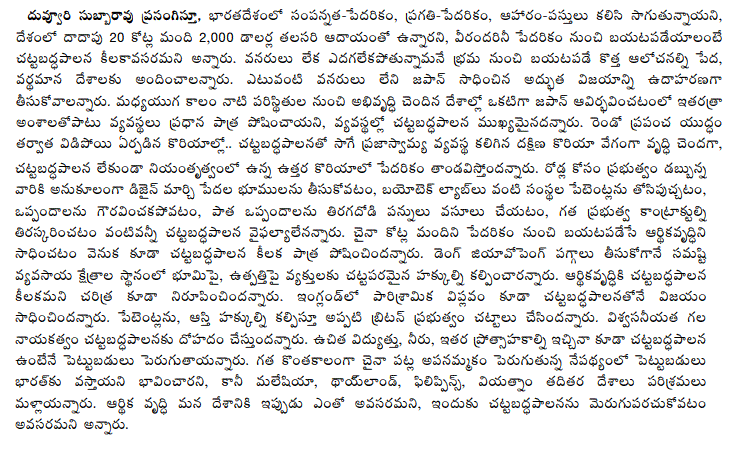
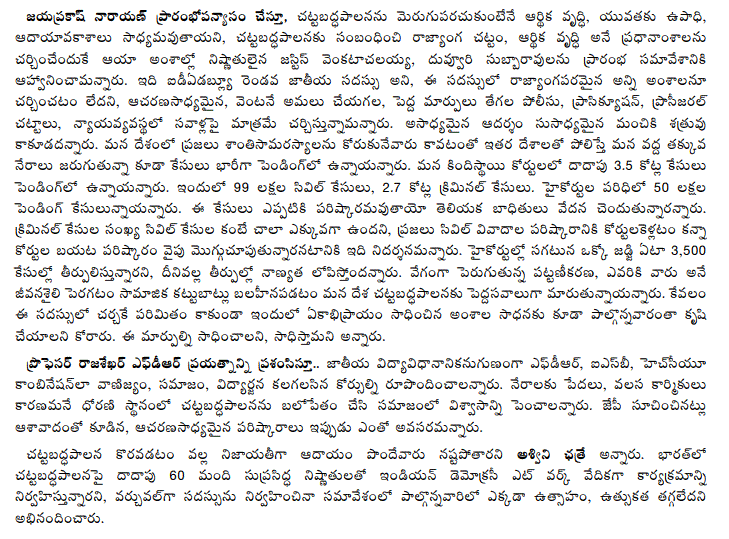
The much-awaited conference on ‘Rule of Law’ was flagged off today with its impressive inaugural session. The inaugural session was attended by Shri M.N. Venkatachaliah, former Chief Justice of India, Shri. D.V. Subba Rao, former governor of RBI, Dr. Jayaprakash Narayana, former IAS and founder of Lok Satta movement, Prof. B. Rajasekhar, pro-vice chancellor of Hyderabad Central University, Prof. Ashwini Chhattre, Director of Bharathi Institute of Public Policy of Indiana School of Business.
Dr. Jayaprakash Narayan started that Rule of Law was chosen as the theme for the conference with great optimism. A rational and pragmatic solution for the challenges plaguing the Indian judicial system can be found, and for that citizens must strive to be a part of the solution, and not a part of the problem. The aim of the conference is to bring together all stakeholders to find workable solutions and recognize that the striving for the impossible best is the enemy of the possible good.
Justice Venkatachaliah stated that looking at the arrears in courts points to deeper malaise in the country and such miscarriage of justice is not witnessed in advanced countries. He also added that approximately Rs. 2 lakh crores of equivalent is lost in the judicial process as wasteful man hours. Another important point he made was that many courts have less clarity on laws and statutes.
Dr. Subba Rao congratulated Foundation for Democratic Reforms for bringing out Advocacy paper 'Rule of Law' in the public discussion. He laid the context of how economic progress and Rule of law is interconnected and the former is only possible with the support of the later. He gave the example of how Singapore, Japan, Korea became prosperous in the last century. The speaker emphasizes that rule of law is a prerequisite for economic growth in any country. The speaker pointed out numerous incidents in which we encounter absence of rule of law.
Prof. Rajasekhar supported Dr. Jayaprakash Narayan’s point regarding the need to find optimistic, pragmatic, and practical solutions, and the need to focus on the practical aspect as the impossible best is often the enemy of the possible good that can be done.
Professor Chhatre started by congratulating Indian Democracy at Work for creating a common platform which will host more than 60 distinguished speakers over a period of week on the theme of 'Rule of Law' in India. He also stated that despite the conference being held virtually, it didn’t hold us back in terms of energy and enthusiasm to participate in this conference. He also extended thanks to all the panels and participants.